Does the Do Not Call Registry Work? What It Actually Stops
Quick Answer
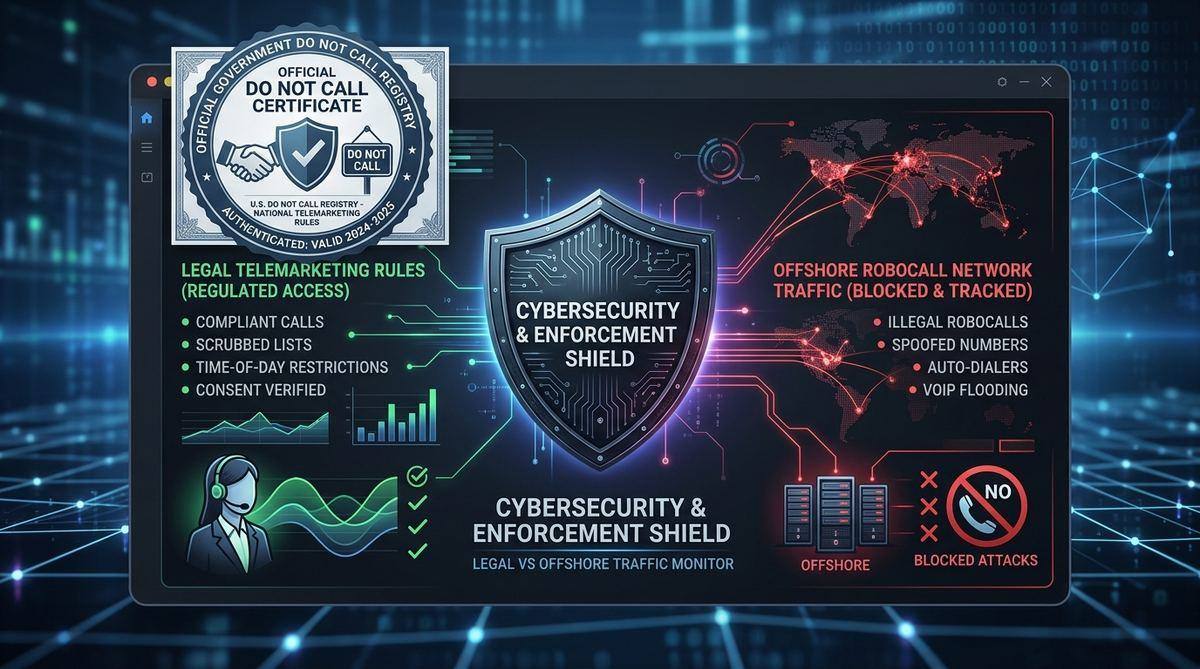
The FTC National Do Not Call Registry legally binds legitimate, US-registered commercial telemarketers (who must scrub lists every 31 days), but illegal scammers and offshore robocallers ignore the registry entirely. Registration reduces sales calls but cannot stop criminal fraud.
The Federal Trade Commission (FTC) National Do Not Call Registry stops lawful telemarketers from calling registered numbers, but it has no technical mechanism to block criminal scammers. As explained in the FTC National Do Not Call Registry FAQs, the registry is a list that tells registered telemarketers what numbers not to call rather than a call-blocking system, so registration will not stop calls from scammers making illegal calls.
How Does the National Do Not Call Registry Actually Work?
Established under the Telemarketing Sales Rule (16 CFR Part 310) and overseen jointly by the FTC and the Federal Communications Commission (FCC), the registry functions as a legal compliance list rather than a technological call filter. Legitimate telemarketing organizations must download and scrub their outbound calling lists against the national registry at least once every 31 days.
When you register your phone number at donotcall.gov, lawful commercial sellers are legally prohibited from placing unsolicited sales calls to your number after 31 days (16 CFR § 310.4). Companies that knowingly violate this rule face federal statutory civil penalties up to $53,088 per violation (as adjusted for inflation, effective January 17, 2025) under 16 CFR § 1.98. In addition to administrative penalties, consumers have statutory private rights to pursue damages directly—see our breakdown on how to sue telemarketers under TCPA rights.
Why Does the Registry Fail to Stop Scam Calls?
The primary reason consumers ask why they receive so many spam calls even after registering is that scammers do not comply with federal statutes. Fraud operations selling fake auto warranties, Medicare schemes, and IRS impersonation scams are already committing felonies; they do not download or honor federal Do Not Call lists.
According to the FTC National Do Not Call Registry Data Book for Fiscal Year 2024, the registry included over 253 million active registrations, yet the FTC received over 2 million unwanted call complaints nationwide. For detailed data on federal enforcement actions and complaint volumes, review our analysis of FTC robocall reporting data. Furthermore, bad actors evade enforcement by falsifying caller information—learn whether caller ID spoofing is illegal under federal law—and routing calls through offshore dialers (read our investigation inside outbound call centers and robocall operations).
High-volume telemarketing networks also bypass suppression lists by operating multi-tier consent arbitrage pipelines, documented in our investigation of the telemarketing lead transfer taxonomy. These syndicates blast unregistered numbers with deceptive pitches where victims discover how agents switch health plans without consent, wonder why someone is calling to lower car insurance, and ask why contractors call about roof repairs after storms. Similar offshore dialers bombard consumers asking if Card Services calling about debt is a scam, training openers to extract manufactured consent despite rules determining whether telemarketers can call you if you are on the Do Not Call list.
What Is the Difference Between Government and Corporate DNC Policies?
It is important to distinguish the federal government registry from an individual company's compliance policy. Under the Telephone Consumer Protection Act (TCPA), every commercial entity must maintain an internal opt-out mechanism. For example, you can review our corporate compliance standards in the Callro corporate Do Not Call policy to see how individual companies process direct opt-out requests.
How Should You Handle Unsolicited Calls That Ignore the Registry?
Because the federal registry relies solely on voluntary legal compliance, stopping criminal robocalls requires active technical filtering on your phone. Filing complaint reports helps federal agencies build enforcement cases—read our guide on how reporting spam calls works. Meanwhile, carrier networks implement cryptographic authentication through the FCC STIR/SHAKEN framework to detect spoofed calls. To protect your line from callers who ignore the registry:
- Register with the FTC: Ensure your number is on donotcall.gov to eliminate compliant sales calls.
- Do not engage: Hang up immediately on automated recordings to prevent list validation.
- Deploy on-device screening: Use call-screening technology that inspects caller authentication before the phone rings. Review our guide to choosing a private spam call blocker to evaluate local hardware protection.
Frequently Asked Questions
How long does it take for the Do Not Call Registry to take effect?
Under FTC rules (16 CFR § 310.4), commercial telemarketers have up to 31 days from the date of registration to remove your telephone number from their calling lists.
Why do I still get spam calls after registering on Do Not Call?
The registry only stops lawful companies that comply with federal law. Scammers, illegal robocallers, and offshore operations deliberately violate telemarketing regulations and ignore the registry.
Who is exempt from the National Do Not Call Registry?
Federal law exempts political campaigns, registered non-profit charities, legitimate telephone surveyors, and businesses with which you have an existing commercial relationship.
How does a company's internal Do Not Call list differ from the federal registry?
The federal registry is a nationwide FTC database. An internal Do Not Call policy governs how an individual company processes direct opt-out requests from its own customers under TCPA guidelines.
Key Takeaways
- The National DNC Registry only stops law-abiding commercial sales companies.
- Criminal scammers and overseas autodialers ignore federal registry regulations entirely.
- Registration remains valuable to eliminate legitimate sales and isolate criminal traffic.
- Pairing the DNC registry with local on-device call filtering provides complete protection.
Protect Your Family Today
Install Callro and give your parents a phone that only rings for real people. 7-day free trial — no payment info required.