Does Reporting Spam Calls Work? What Actually Happens
Quick Answer
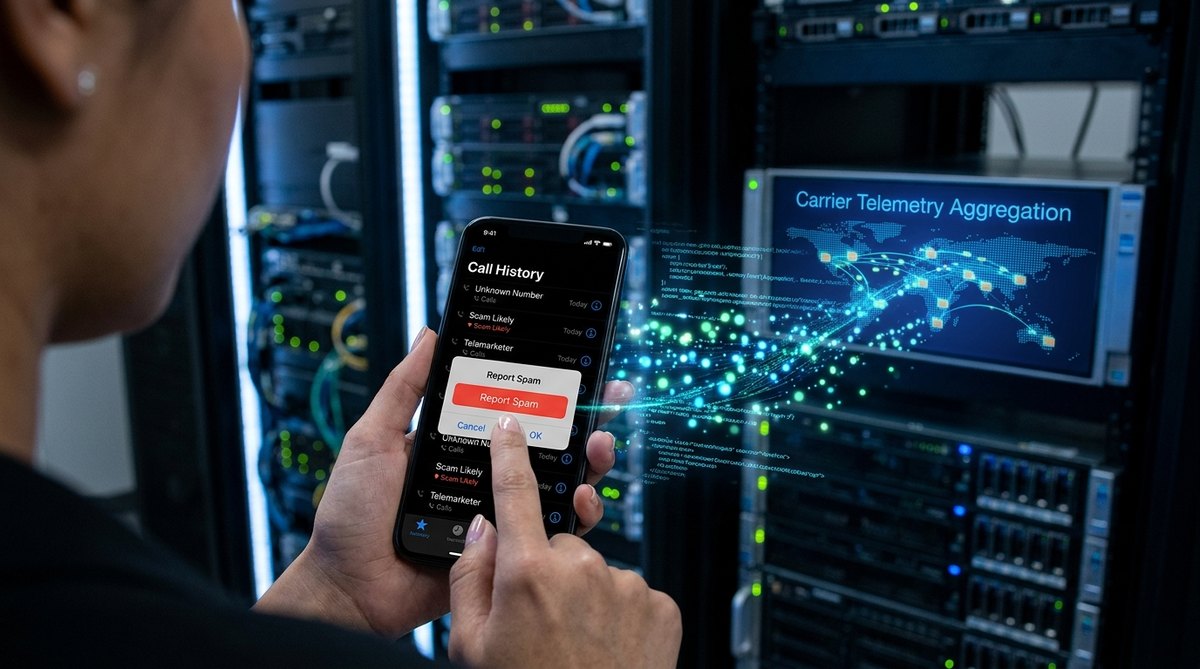
When you report a number as spam, your smartphone transmits the number and call timestamp to your carrier or operating system provider (such as Google Phone). These services aggregate user reports to update community spam warnings, though reporting will not stop the caller immediately because autodialers rotate through disposable VoIP numbers rapidly.
When you report a number as spam, your mobile dialer transmits the caller's phone number and timestamp to your operating system provider or wireless carrier. According to Google Phone app support documentation, when users report an unwanted number, Google uses that call information to determine whether future calls from that number are likely spam and warn other users on incoming call screens. While submitting these reports helps update network-level spam warnings over time, understanding this reporting pipeline explains why manual reports rarely stop the next wave of robocalls from reaching your device.
What Happens Inside the Telemetry Pipeline When You Report Spam?
When you submit a spam report on your mobile phone, the device transmits a telemetry payload to your cellular carrier, operating system vendor, or third-party dialer provider. This report typically contains:
- The originating phone number displayed on Caller ID.
- The timestamp and duration of the inbound call.
- The user-assigned classification (e.g., general spam, telemarketing, or fraud).
The receiving analytics platform aggregates these individual reports against national calling data. When the volume of negative reports for a specific number crosses a predefined mathematical threshold, the carrier updates its centralized database to tag subsequent calls from that number as "Spam Likely" or "Potential Fraud."
Why Crowdsourced Reporting Lags Behind Autodialers
The fundamental limitation of crowdsourced spam reporting is latency. The threshold aggregation process requires time:
- Reporting Delay: A significant number of recipients must receive the call, decline or answer it, and manually submit a spam report.
- Reputation Processing: Analytics engines must process the incoming telemetry and verify that the reports are not malicious false positives against legitimate businesses.
- High-Speed Dialing Waves: Robocall operations typically blast through high volumes of telephone numbers in a concentrated calling window, then abandon that number pool completely.
By the time a carrier algorithm updates a number's reputation score to "Spam Likely," the scammers have already discarded the caller ID and transitioned to a fresh block of numbers. For an explanation of how dialers cycle through numbers during active campaigns, read why autodialers cycle through numbers.
Why Filing FTC Complaints Still Matters
While submitting complaints to the Federal Trade Commission at ReportFraud.ftc.gov or DoNotCall.gov will not block a call on your smartphone tomorrow (see our breakdown on whether the National Do Not Call Registry works against active scams), federal complaint records are essential for macro enforcement. As noted in FTC reporting guidelines, law enforcement agencies analyze consumer reports to identify and take action against the people responsible for illegal calls and scams, while reported numbers are released each business day to aid carrier blocking and labeling efforts.
The Proactive Alternative: On-Device Pre-Ring Interception
Rather than waiting for a crowdsourced database to catch up to an active scam campaign, modern smartphone defenses rely on automated pre-ring call screening. By reading carrier STIR/SHAKEN verification status, telephone number formatting, and burst patterns directly on your handset, call screening apps can block or silence unverified calls so the phone does not ring.
Callro does not request access to your contacts, your phone's call log, or your microphone. To see how privacy-first screening compares with cloud-based analytics apps, read our guide on how call blockers inspect telemetry.
Frequently Asked Questions
What happens when you tap 'Report Spam' on your smartphone?
When you report a call as spam on your mobile dialer, your phone sends the number and call timestamp to your carrier or operating system provider. If enough users report the same number, the system updates its reputation score to display 'Spam Likely'.
Why does reporting a spam number feel ineffective?
Scammers rarely call from the same number twice. By the time enough users submit reports to trigger a 'Spam Likely' label (often several days), the autodialer operation has already moved to a new pool of numbers.
Should you still report spam calls to the FTC?
Yes. While FTC reports will not block calls on your personal phone on your device, federal agencies and state attorneys general use consumer complaint databases to identify large illegal VoIP gateways and bring civil enforcement actions.
What is the fastest way to stop unwanted calls from ringing your phone?
The most effective on-device solution is automated on-device call screening, which reads the carrier's STIR/SHAKEN verification status as reported by Android and evaluates telephony metadata to block unverified callers before your ringer sounds.
Key Takeaways
- Reporting spam numbers helps federal agencies build enforcement lawsuits against gateway providers.
- Individual number reports do not stop incoming calls immediately because scammers discard numbers rapidly.
- Crowdsourced blocker databases rely on aggregated user reports to update community blocklists.
- Immediate protection requires on-device call screening that drops unverified spoofed calls locally.
Protect Your Family Today
Install Callro and give your parents a phone that only rings for real people. 7-day free trial — no payment info required.