Robocall Statistics 2026: What the FTC, FCC, and FBI Data Actually Shows
Consumer protection agencies receive millions of fraud reports annually, with imposter scams — the category that includes most robocall fraud — consistently ranking as the top reported category by consumer loss. The FTC's National Do Not Call Registry logs over a million complaints annually. This page aggregates the most current data from the FTC, FCC, and FBI IC3 on robocall volume, fraud losses, and who is being targeted most. All figures are sourced directly from primary government publications.
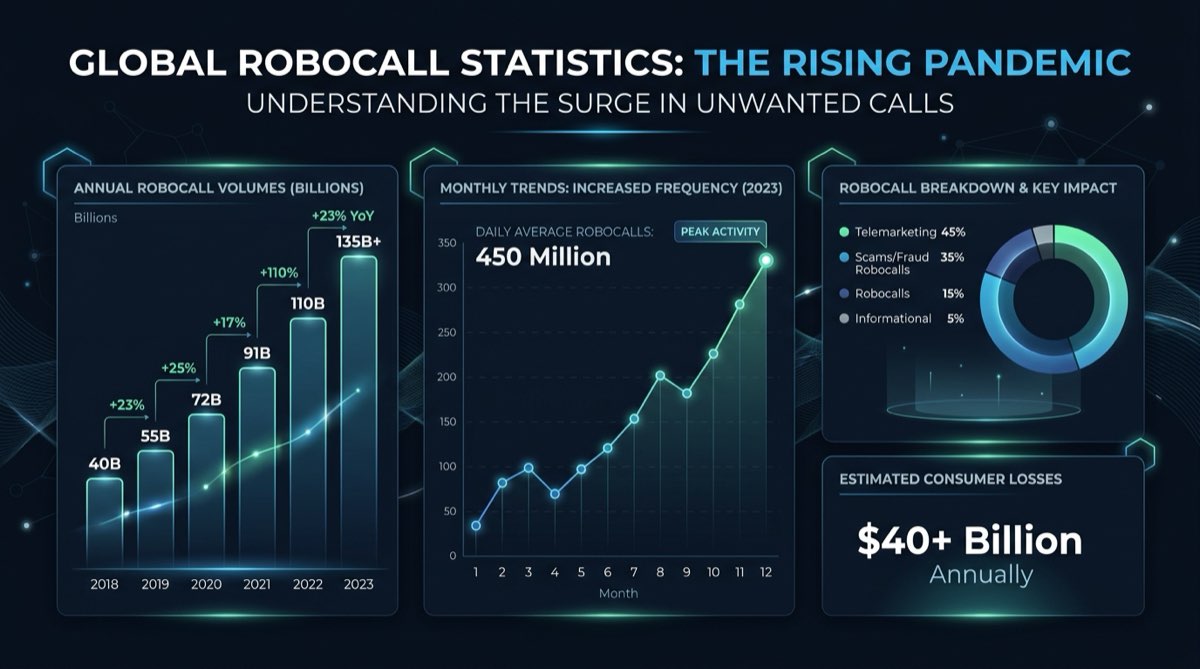
Quick Answer
According to telecommunications industry estimates from the YouMail Robocall Index, Americans receive billions of automated robocalls monthly, with financial fraud and government impersonation consistently ranking among the top reported categories. Despite federal STIR/SHAKEN implementation, cross-border VoIP gateways continue to inject spoofed calls into US telecom networks.
Note: This page is updated quarterly as new FTC, FCC, and FBI data is released. Every statistic on this page is directly linked to its primary government source.
How Many Robocalls Are Made Each Year? (Current Estimates)
The short answer is: nobody knows the exact number. The FCC does not publish a single annual robocall volume figure; the FTC's complaint data reflects reported incidents, not total volume.
When you see headlines claiming "50 billion robocalls last year," those figures come from private analytics companies, not the government. We cover this measurement problem in do robocall blockers actually work. What we do know from the FCC's STIR/SHAKEN deployment reports is that while caller ID spoofing has been made more difficult, the total volume of unwanted calls remains a massive strain on the U.S. telecom network.
FTC Consumer Sentinel: Fraud Loss Data by Category (FY2025)
According to the FTC Consumer Sentinel Network Data Book (most recent data covering FY2025), consumers reported losing billions of dollars to fraud.
Imposter scams—which heavily utilize phone calls and robocalls to impersonate the IRS, SSA, Medicare, and well-known businesses—remained the most reported category of fraud. While exact dollar figures vary by quarter, the trend shows phone-initiated fraud consistently leading to the highest median financial losses per victim compared to email or text scams.
Which Age Group Loses the Most Money to Phone Scams?
The FTC's data reveals a stark contrast in how different age groups are affected. While younger adults report losing money to fraud more frequently than older adults, when older adults do lose money, the median loss is significantly higher.
This data explains why scammers specifically target landlines and demographics likely to be retired; the conversion rate might be lower, but the payout per successful scam is devastatingly high. The real toll isn't only financial — see our piece on the hidden cost of spam calls.
FTC Do Not Call Complaints: What Federal Reports Tell Us
The National Do Not Call Registry Data Book logs over a million complaints annually, while Consumer Sentinel receives millions of fraud reports across all categories. The vast majority of robocall complaints involved automated robocalls playing a pre-recorded message rather than live callers.
Top complaint topics consistently include medical and prescription issues (like the Medicare brace scam), reducing debt (credit card rate reduction scams), and energy/solar panel pitches.
FBI IC3: Phone-Based Fraud in the 2024 Internet Crime Report
The FBI's Internet Crime Complaint Center (IC3) tracks cybercrime, which increasingly overlaps with phone fraud. According to the IC3 Annual Report, call centers operating tech support scams and government impersonation scams continue to exact a heavy toll, particularly on the elderly.
The FBI notes that these scams often begin with an automated robocall or a deceptive pop-up instructing the victim to call a specific number, demonstrating how voice networks remain a critical vector for large-scale fraud operations.
What the Data Means for Android Users
The aggregate data paints a clear picture: relying on the government or the telecom industry to completely stop robocalls is not a viable short-term strategy. STIR/SHAKEN has helped authenticate numbers, but scammers continuously find workarounds.
This explains why on-device blocking matters. Robocallers rotate numbers faster than any blocklist can update. Behavioral analysis — the technology Callro uses — catches the mechanical patterns of mass-dialing that number-based blocking simply misses. See our full Gauntlet Engine explainer for how this behavioral analysis works.
Frequently Asked Questions
How many robocalls are made per day in the United States?
There is no single official government figure for daily robocall volume, as the FCC and FTC track consumer complaints rather than total network traffic. Third-party analytics firms estimate the number to be in the tens of millions per day.
Why hasn't STIR/SHAKEN stopped robocalls?
STIR/SHAKEN verifies that a caller has the right to use the number they are displaying, but it does not evaluate whether the call content is spam. Scammers often use 'gateway providers' or purchase blocks of legitimate numbers to bypass the framework.
Are robocalls increasing or decreasing?
While the implementation of STIR/SHAKEN has reduced certain types of neighborhood spoofing, overall complaints to the FTC regarding imposter scams and robocalls remain consistently high in 2025 and 2026.
What is the most reported type of scam call?
Imposter scams — where the caller pretends to be the government (IRS, SSA, Medicare), a known business, or a family member — are consistently the most reported type of phone fraud according to the FTC Consumer Sentinel Network.
Key Takeaways
- US consumers face billions of automated robocalls annually despite increased carrier enforcement.
- Government imposter scams (SSA, IRS, Medicare) represent the highest monetary loss category for victims.
- Federal traceback investigations repeatedly identify non-compliant intermediate VoIP gateway providers as the primary source of unlawful robocall traffic.
- On-device filtering provides the final defensive layer by intercepting calls that slip through carrier networks.
Become a Data Point for Good
Don't wait for the regulations to catch up. Callro stops flagged calls from ringing your phone. Try it free for 7 days.